Just following on from my previous post about Australian green tea, and whether it should be called sencha or not - Jackie, for example, seems to feel NOT - but what more exciting name than just 'Australian green tea' could be used instead?
For example: Oolong tea grown in New Zealand is called Zealong... Apparently the tea is very good but I am afraid the name doesn't really work for me; it just sounds kind of silly.
Moreover, what if there were more than one kind of tea being produced? For example, green tea grown in Australia but processed as for longjing, chun mee, bi luo chun? Clearly just calling the whole lot 'Australian green tea' wouldn't cut it - you would need to differentiate somehow. Would 'Australian XYZ-style tea' be adequate? I am a bit less sure now than I was when I wrote the previous post.
What do you think?
Showing posts with label thought of the day. Show all posts
Showing posts with label thought of the day. Show all posts
Tuesday, 15 March 2011


Friday, 25 February 2011
My proudest moment
Last Sunday Tennant Pippin and I went over to my sister's new place to check it out for the first time. Naturally my lovely sister brewed me up a pot of tea (T2 Creme Brulee, tres nice).
Pippin was chattering away and I wasn't paying much attention, but then I heard Tennant say, 'Hey guess what? Pippin just said "TEA"!'
And it was true. Pippin was pointing at my mug and saying, as clearly as he could, 'TEA!'*
I was So. Proud. I almost cried.
Then, this morning (yes, it gets better!!) we were all just about to head downstairs for breakfast and I said 'I'll put the kettle on.'
Pippin immediately said 'TEA!'
We tried to get him to say it again: 'Pippin, what happens when mummy puts the kettle on?' - but all he would do was giggle and say 'Yay!' Also an entirely correct response, I would note.
He is a boy after my own heart. Oh, I am so proud.
Here he is having a teaspoonful or so of some cooled Giddapahar autumn flush after his breakfast:

*it comes out more like 'K-HEE!' (he is not super good at 't' words yet) but it is entirely clear what he means. I am not wishfully thinking this.
Tuesday, 15 February 2011
A couple of things
I've had a couple of interesting comments posted lately and I wanted to respond to them where more people may see the reply.
Alex commented on my post about What's a letter worth? :
Re: the first point he makes: I agree, I often prefer the more robust-flavoured teas myself (although I do enjoy a first flush Darjeeling). Sometimes I feel a bit bad about this: does it mean I am actually not as sophisticated a tea drinker as I like to imagine myself? But, really, does that matter? I like what I like... and there it is. Of course it's also good to try different things, of course and to be open to putting aside my preconceptions about tea (like with puerh for example, but more on that in another post) because I might be pleasantly surprised.
In relation to Alex's second point, I also agree - I have also picked up high grade teas for a bargain price, for example when they are from the previous season and the new crop is coming in and commanding the higher prices. In my experience though, this is something that is most likely to happen with online and, in particular, specialist tea vendors such as Thunderbolt Tea in Darjeeling. It seems to me that the average Australian consumer walking into a bricks and mortar store would be unlikely to be confronted with information about the latest, freshest teas and given an opportunity to purchase previous crops for a cheaper price regardless of grade... if that makes sense. Even in a store with a broad range of quality teas you would have to know what you were looking for, and be prepared to ask the staff about it if you wanted something so specific. Does anyone else have an opinion about this, from an Australian perspective or from elsewhere?
In response to my post on Sustainable, organic and fair trade tea, Jenny asked
In general, I would have to say: No, not specifically. I do my best to purchase as much as I can from companies who produce high quality goods - tea, food and so on - and this sometimes means that the products are organic (e.g. at the farmers' market) and sometimes that the company has a strong social ethic (e.g. Thunderbolt Tea). I like to purchase close to the source, hopefully ensuring that more of the money goes directly to the people involved - again buying tea from Thunderbolt Tea is a good way to do this and Obubu Tea in Japan is also excellent (and all of their teas are delicious as well).
It is important to me that the products I consume are as ethical as possible - but as the interview I linked to in the previous post indicates, ethical production and consumption are not as simple and clear-cut as one might think!
Alex commented on my post about What's a letter worth? :
The few times I've tasted tea from the same harvest and garden of different grades, I have not always preferred the "better" grades. Sometimes, higher grades taste more delicate, and I may want a more robust tea.
...
Also, you can't generalize about the price of grades. I've picked up some FTGFOP1 Darjeeling First Flush when it was a bit late and out of season, and yet still fresh and outstanding quality, for a lower price than a lot of "lower" grades.
Re: the first point he makes: I agree, I often prefer the more robust-flavoured teas myself (although I do enjoy a first flush Darjeeling). Sometimes I feel a bit bad about this: does it mean I am actually not as sophisticated a tea drinker as I like to imagine myself? But, really, does that matter? I like what I like... and there it is. Of course it's also good to try different things, of course and to be open to putting aside my preconceptions about tea (like with puerh for example, but more on that in another post) because I might be pleasantly surprised.
In relation to Alex's second point, I also agree - I have also picked up high grade teas for a bargain price, for example when they are from the previous season and the new crop is coming in and commanding the higher prices. In my experience though, this is something that is most likely to happen with online and, in particular, specialist tea vendors such as Thunderbolt Tea in Darjeeling. It seems to me that the average Australian consumer walking into a bricks and mortar store would be unlikely to be confronted with information about the latest, freshest teas and given an opportunity to purchase previous crops for a cheaper price regardless of grade... if that makes sense. Even in a store with a broad range of quality teas you would have to know what you were looking for, and be prepared to ask the staff about it if you wanted something so specific. Does anyone else have an opinion about this, from an Australian perspective or from elsewhere?
In response to my post on Sustainable, organic and fair trade tea, Jenny asked
How about you? Do you go for organic tea(products)?
In general, I would have to say: No, not specifically. I do my best to purchase as much as I can from companies who produce high quality goods - tea, food and so on - and this sometimes means that the products are organic (e.g. at the farmers' market) and sometimes that the company has a strong social ethic (e.g. Thunderbolt Tea). I like to purchase close to the source, hopefully ensuring that more of the money goes directly to the people involved - again buying tea from Thunderbolt Tea is a good way to do this and Obubu Tea in Japan is also excellent (and all of their teas are delicious as well).
It is important to me that the products I consume are as ethical as possible - but as the interview I linked to in the previous post indicates, ethical production and consumption are not as simple and clear-cut as one might think!
Sunday, 13 February 2011
Sustainable, organic, fair trade tea
I am quite the groupie of Nigel Melican of Teacraft Ltd - his knowledge and experience in the industry is vast and I am always interested in what he has to say. So, you can imagine how rapt I was to discover that Cinnabar of Gongfu Girl had interviewed Nigel at last year's World Tea Expo and shared the interview on Cha Dao.
If you care about issues of sustainability, organic farming and fair trade - in relation to tea in particular of course, but I think there is much in this interview that applies to agriculture and trade in general - then you should read this. The following excerpt is one I found particularly thought provoking:
The interview is relatively lengthy, so it's been divided into three parts. Definitely worth every minute of your reading time and worth coming back to. Check it out here!
Part One
Part Two
Part Three
If you care about issues of sustainability, organic farming and fair trade - in relation to tea in particular of course, but I think there is much in this interview that applies to agriculture and trade in general - then you should read this. The following excerpt is one I found particularly thought provoking:
NM: I'll give you an example of the dilemma that you might get into. I was working with a new tea grower in Hawaii -- not one of the small guys that we've seen at the Expo, but someone who wanted to do it on a hundred-acre scale, 200-acre scale. He wanted to be organic, said the production must be organic. He was a berry farmer on the mainland, and he always had an organic farm, and he wanted to have an organic tea farm. So we started off and sourced his tea and his raw materials from Africa and got it planted, and his soil was not acid enough, which is unusual for Hawaii, but this was an old sugar-cane plantation and they'd put down a lot of chalk, to benefit the sugar cane. This was 20 years ago, but it was still there. The normal way that you'd acidify soil for tea is to put sulfur on it. Sulfur is recognized by the organic people; they're happy with it. So he goes off to his supplier and when he sees the sulfur that he's offered, he says, "where does it come from?" and they say it's a by-product of the petrochemical industry, and he throws his hands up in horror! So we look and see what else we can get. It's possible to get sulfur which is rock sulfur, mined sulfur. The dilemma is, would you rape the countryside with big holes, ripping out rock sulfur, or would you use a by-product of the petrochemical industry that has to go somewhere, and is at least greening the petrochemical industry at least a little bit?
C: Why would the organic regulations say that you couldn't use petro-chemical by-products?
NM: the regulations don't say that you shouldn't, but they would prefer that you use the natural sulfur.
C: "Organic" meaning that you take it from the earth regardless of consequences? That makes no sense.
NM: No it doesn't make a lot of sense. That's why I say that sustainability and organic should be done with some degree of realism.
The interview is relatively lengthy, so it's been divided into three parts. Definitely worth every minute of your reading time and worth coming back to. Check it out here!
Part One
Part Two
Part Three
Monday, 31 January 2011
What's a letter worth?

You know those letters that you see after the name of a tea - GFBOP, TGFOP, SFTGFOP1 etc etc - it's funny the effect they can have on my purchasing habits.
These letters are, for those of you who don't know, part of a grading system for orthodox-style black teas, primarily those from India and Sri Lanka (Ceylon as it used to be known). The basic is the OP - 'orange pekoe'. Many people will be surprised to learn that this has nothing to do with orange flavour in any way; it is actually all to do with leaf size. If there's a B in front of the OP, that stands for 'broken' and means the leaf pieces are not as whole as they could be.
T, G, F all stand for 'tippy' 'golden' and 'flowery' respectively and relate to the number of tips (leaf buds, which tend to turn golden rather than brown during the production process) in the tea. The more buds, the younger the leaves were at harvest, the finer the pluck, the more expensive the tea. Stick an S for 'special' and an F for 'finest' on the front of all that and you have a very fine tea indeed...
Or that's the theory anyway. In reality, the processing of the leaf probably has at least as much impact on the quality of the final product as the initial pluck. However, many people wandering into your average tea shop would not necessarily know this; and there is a bit of a 'wow factor' involved in purchasing something that has lots of letters after its name (just like looking at the business card of someone with a lot of university degrees I suppose). After all, wouldn't you like to have a bit of the most special (indeed the most finest??) tea in the shop?
But what are these letters worth really?
From a price perspective: The Assam that I wrote about the other day (see here) retails from Tea Leaves for the very reasonable price (as Alex pointed out in the comments) of A$5.50 for 100g (about 3oz). This tea is a TGFOP. In comparison, a STGFOP1 Assam retails from the same vendor for $10.45, nearly double the cost for the same quantity. These two teas may not be exactly comparable of course; for one thing, the more expensive tea is identified as a single estate tea whereas the one I bought is unidentified, presumably blended from a mixture of estates.
I almost came away with the more letter-heavy Assam; the main reason I didn't was because I happened to recall that this is a grading system based on size, not taste quality. So I reckoned I would save my pennies (well, only to spend them on some Dragonwell, ahem) and went with the cheaper version. Very happy I am with it too.
But even so - I wonder if the STGFOP1 would taste twice as nice? Or would I only think it did because it was more expensive? And anyway, doesn't it all come down to personal taste in the end? Perhaps when I run out of my current stock (which I am going through at quite a pace, I must say) I will get some of both to compare.
Wednesday, 13 October 2010
Do you name your teapots?
Some people do! Brett at the Black Dragon Tea Bar has a whole League of Pots... with superpowers... wouldn't want to mess with any of these guys or gals. I rather like 'Chip' myself -
 - his brewing specialty is Assam. Brett rescued him from a thrift store... I'm sure they are both glad about that!
Some little yellow teapots have a whole lot of personality all of their own, and even conduct interviews with other personable teawares.
To be honest it never really occurred to me to name my teapots. Perhaps I should? I wonder if they feel unloved, to go unnamed.
Some little yellow teapots have a whole lot of personality all of their own, and even conduct interviews with other personable teawares.
To be honest it never really occurred to me to name my teapots. Perhaps I should? I wonder if they feel unloved, to go unnamed.
Sunday, 26 September 2010
Size Does Matter
Teapot-wise, that is.
Think about it. The more water you put into a pot, the hotter it will stay. A smaller amount of water will cool faster, even if you warm the pot first. This will affect the way that the tea brews when you put it into the pot. Even if a tea is meant to be brewed with water that has just come to a full boil, it is not meant to be kept at that temperature but to cool gradually as it steeps. This is why it is not recommended to place a tea cosy over your teapot while the leaves are still in there; the tea will stew.
I also think it is why some teas do not taste as good when brewed in a larger pot (much as I love my 6-8 cup London Pottery teapot, seen here coyly wearing its tea-cosy [tea-leaf free], it is better suited to herbal and robust black teas rather than anything more delicate).

Sometimes even brewing a two-cup pot rather than a single-cup pot can make a difference; I feel that the delicious Keemun from SanTion tastes better only brewed a single cup at a time, for example. Have you had a similar experience with the teas that you drink?
Wednesday, 8 September 2010
Spare Teacups?
No problem! Check out the nifty things you can do with mismatched, spare teacups...
Jess made a teacup succulent garden - doesn't it look beyond terrific, like something from a magazine shoot!

And Deb shares tutorials on how to make mini cake stands out of old plates and other crockery, including teacups - great for cupcakes or small things.
I would love to do either or both of these activities, and they seem pretty well within my creative abilities, but if you are totally talented and capable of something really challenging, then take some inspiration from this 'storm in a teacup' which I spotted on Tea for Joy:

Wednesday, 25 August 2010
What's your brewing style?
This is how I brew my tea most of the time:
1. Boil water in my stovetop glass kettle (actually a coffeepot, minus the percolator bit, that belonged to my parents - but seeing as they don't use it any more, I nabbed it [politely]).
2. Warm my glass teapot with a bit of the hot water, then pour that water into my green teapot to warm it as well.
3. Put the leaves loose into the glass teapot and pour on the boiled water (after it has cooled a little if necessary).

4. Steep the appropriate amount of time (or longer, if I get distracted... Whoops).
5. Strain the tea from the glass teapot into the green teapot. Drink and enjoy!
So why all the high maintenance and creation of more washing up than is strictly necessary? Well, I can't prove it with science but I really do think that allowing the leaves to float freely produces a better cup of tea... They have the chance to fully open and swirl around. Given that most of my teapots hold more than one cup's worth of tea, though, I need to decant it into a second teapot to prevent oversteeping.

Also, while my glass teapot is good because you can see how pretty the leaves look while they brew, it does have a badly chipped spout and doesn't pour well, making it less than ideal for serving the tea, especially to guests.
Friday, 23 July 2010
Tea Stuff Roundup
I have read a few interesting tea blog articles over the last few days and thought some of them worth sharing.
This article 'Whose Tea Is That?' by Michael J Coffey of 'Tea Geek' has been getting quite a bit of kudos in my Twitter stream - deservedly so. Michael points out that most of the time we just don't know where our tea is coming from - and what's more, can you really say that one company's tea is better than another if they originally came from the same source? What is there to like about one, but not the other, in this case?
The issue is not just confined to single-origin unblended teas, either; in fact perhaps it's even more problematic in the case of flavoured teas. Take this quote from Charles Cain, who writes a fascinating blog about the process of opening a bricks and mortar tea store for a large US tea company, Adagio:
On the plus side it does mean you can shop around til you find the tea you like at the best price! Cloud, silver lining, etc.
Enough with the grumping, I didn't mean for this to be a depressing entry. Let's cheer ourselves up with a post from the awesome Stephane at Tea Masters (if you can't read the French, he does post a lot in English, and his photos are always worth a look). In this one he brews up a low-mountain oolong from Zu Shan and explains how important it is when starting out with tea to really get a feel for it. It can be so tempting to get a lot of small amounts of different teas and not really learn how all the variables (water, temperature, amount of leaf, even time of day) affect a single tea and your enjoyment of it. This is really sound advice and something I am going to pay more attention to.
This article 'Whose Tea Is That?' by Michael J Coffey of 'Tea Geek' has been getting quite a bit of kudos in my Twitter stream - deservedly so. Michael points out that most of the time we just don't know where our tea is coming from - and what's more, can you really say that one company's tea is better than another if they originally came from the same source? What is there to like about one, but not the other, in this case?
The issue is not just confined to single-origin unblended teas, either; in fact perhaps it's even more problematic in the case of flavoured teas. Take this quote from Charles Cain, who writes a fascinating blog about the process of opening a bricks and mortar tea store for a large US tea company, Adagio:
The supply chain for most teas sold in the US is ridiculously incestuous. Half of wholesalers buy from other wholesalers. It's not uncommon to find the same flavored tea, blended by the same large wholesaler, sold at dramatically different price points under the names of quite a few smaller wholesalers. Many independent retailers pride themselves on choosing only the finest teas for their collection. As proof of this, they buy from many different tea wholesalers. I've heard shop owners boast of having more than 30 tea vendors. The incredible irony is that I've also heard tea wholesalers boast of selling to the same shop owner under the name of a half dozen different companies.Read the rest of Charles' article here. Kind of depressing, isn't it. I suspect that things are not that different in Australia, although perhaps on a smaller scale; I know that in most retail tea shops I see a whole bunch of very similar blends, sometimes under slightly different names (think Monk Pear-type blends, French Earl Grey variants, Blue Mountain blends etc etc) that almost have to be imported from a bulk tea supplier somewhere in the world. They're just too similar to be individually made by each of the shops concerned. I'm not saying that these shops have NO originality because most of them probably do in some areas. I've just always found it a bit disappointing I suppose when I find that something I thought was unique actually isn't.
On the plus side it does mean you can shop around til you find the tea you like at the best price! Cloud, silver lining, etc.
Enough with the grumping, I didn't mean for this to be a depressing entry. Let's cheer ourselves up with a post from the awesome Stephane at Tea Masters (if you can't read the French, he does post a lot in English, and his photos are always worth a look). In this one he brews up a low-mountain oolong from Zu Shan and explains how important it is when starting out with tea to really get a feel for it. It can be so tempting to get a lot of small amounts of different teas and not really learn how all the variables (water, temperature, amount of leaf, even time of day) affect a single tea and your enjoyment of it. This is really sound advice and something I am going to pay more attention to.
Saturday, 3 July 2010
Useful things to do while you wait for the kettle to boil
#5: Hunt frantically for a clean teapot then resign yourself to having to wash one of the dirty ones.
Friday, 2 July 2010
Useful things to do while you wait for the kettle to boil

#4: Find your prettiest cup and saucer... The special set you hardly ever use cos it's too good. It's not! Fetch it now!
Thursday, 1 July 2010
Useful things to do while you wait for the kettle to boil
#3: Blog about things to do while you're waiting... sheer genius.
Wednesday, 30 June 2010
Useful things to do while you wait for the kettle to boil
#2: Get yourself a piece of cake or some nice biscuits... like HobNobs. Yum!

PS: the chocolate-coated ones are more fun.
PPS: I like that HobNobs have their own Wikipedia entry.
PPPS: If you were super-organised, you could make your own. I recommend this cake, and these biscuits!

PS: the chocolate-coated ones are more fun.
PPS: I like that HobNobs have their own Wikipedia entry.
PPPS: If you were super-organised, you could make your own. I recommend this cake, and these biscuits!
Tuesday, 29 June 2010
Friday, 4 June 2010
Oh, and one more thing...
... that I like about the Ujinotsuyu website:

Nice life with a cup of tea... What more could one ask for?

Nice life with a cup of tea... What more could one ask for?
Monday, 10 May 2010
Market Wrap
So, last Saturday was my first ever market stall for Joie de Tea. Overall, I am pretty happy with the results - I didn't turn a profit but I nearly did; and I learnt a lot as well, in the best way - by experience. The Malvern Town Hall was a beautiful venue too; all indoors and the ceiling of the main hall looked like it was designed by Wedgwood - stunning in blue and white and gold.
Here's some photos, kindly taken by my husband who did a beautiful job of looking after Pippin all day!


Here's some photos, kindly taken by my husband who did a beautiful job of looking after Pippin all day!


So, what did I learn?
c\_/ that the lead-up to a market is a lot of work;
c\_/ that a lot of people who go to markets are - surprise - like me, and prefer just to browse and/or are shy about talking to stallholders;
c\_/ that I need to merchandise my stall better - more height, more variety, more 'clutter' to make it look good (but I've got some great ideas for next time, involving things like stacks of books and that kind of thing, product information, signage and brochures);
c\_/ that I need to work on my patter with the customers... got to get over that shyness! and
c\_/ that it is really, really nice to have an almost-completely baby-free day once in a while! My goodness, how different it was to my usual daily routine!
So many thanks to the friends who stopped by to keep me company and to all the lovely customers that I had. All in all I'm very pleased with the whole experience and I think I will apply for another stall at the Modish Market - perhaps not the June one, that might be a bit rushed to get all the things organised that I would like to - but for August. I'll keep you posted!
Monday, 3 May 2010
Market prep a-go-go!
In case you were wondering about the blog silence over the last week or so, it's because I have been more or less frantically preparing for the Modish Creators Market at the Malvern Town Hall which is being held THIS SATURDAY, 8 May. My first market stall for Joie de Tea and I am both excited and nervous.
However, thanks to some wonderful help from the best mum ever, who cut ribbons and tied labels onto dozens of bags of tea for me last Friday (and maintained it was fun! don't you love her!) I am just about organised.
Here is a sneak preview of my table layout which Mum and I trialled on Friday...


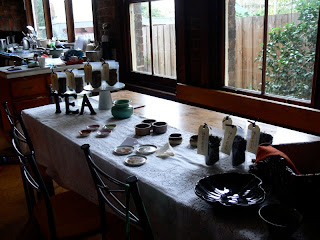
Check out the Modish Creators Market blog for lots of great info about the stallholders... including my interview... it's going to be a great day and if you're in Melbourne I'd love to see you there!
However, thanks to some wonderful help from the best mum ever, who cut ribbons and tied labels onto dozens of bags of tea for me last Friday (and maintained it was fun! don't you love her!) I am just about organised.
Here is a sneak preview of my table layout which Mum and I trialled on Friday...


Check out the Modish Creators Market blog for lots of great info about the stallholders... including my interview... it's going to be a great day and if you're in Melbourne I'd love to see you there!
Monday, 19 April 2010
Behind the Cup... with Eric from Tea Finely Brewed

I can think of few better ways to kick off the week than with an interview with Eric Daams, the tea aficionado behind Tea Finely Brewed. I was lucky enough to meet fellow-Melbournite Eric in person a couple of months ago (over some tea of course) and it was great to hear about his experiences with tea, blogging and family life. Tea Finely Brewed encompasses a tea blog, a tea marketplace which allows you to compare similar offerings from different tea companies, and a 'beginner's guide to tea' with much useful information.
How did you become enthused about tea and what is it that you like most about it?
I think the thing that most excites me about tea today is the breadth of variety. You could try a new tea every week for a year and you'd still be scratching the surface.
To begin with though, I think my motivation for liking tea had something to do with that dark force of the hot beverage world: coffee. I'm someone who likes to do things differently to those around me, so as the youngest boy growing up in a family of coffee drinkers, I decided to become a tea drinker. After years of tea bags in which I slowly exhausted the supermarket choices, I started venturing into loose leaf teas a few years ago. Once you start on loose leaf tea, the world (of tea) opens up to you.
How would you define Australian ‘tea culture’ based on your experience and observations? Have you noticed any changes over time (including your own tea preferences) and what do you think has driven these changes?
For a country with such a vibrant coffee culture, it's sad to see how the Australian tea experience languishes behind. It never ceases to confound me how a café serving amazing coffee can serve their tea-drinking patrons Lipton or Twinings tea bags -- while charging us $3.50 it!
The emergence of T2 and other Australian-based loose leaf tea brands seems to be a sign of change. I'm not crash hot on T2 — I think they're overpriced and capitalizing on a market that is barely aware of quality tea — but I do believe that they're a harbinger of better things to come.
Any thoughts on the direction that tea is headed?
I think tea culture is going to boom in much the same way that coffee culture has boomed in Australia. At the moment, I can think of a handful of restaurants where I could go to have quality tea with my lunch -- they're all Asian restaurants, of course. With time, I believe we'll see that spread into more and more places.
When I was in New Zealand about a year and half ago, I noticed that quite a few of the cafés offered a great range of teas. How often do you go to an Australian café where they offer sencha, dragonwell and gunpowder green tea? Give it ten years, and I think we'll have more places like that around.
What do you think the greatest challenges are for Australian tea consumers and/or businesses? e.g. is it easy for you to find the kinds of teas you enjoy in Australia or do you mostly purchase from vendors in other countries?
One of the perks of blogging about tea is that a lot of companies send me their tea, free of charge. I'm thankful for that, because if I didn't have companies sending me their teas, I would be severely limited by what is available on the market here. I've shopped at Tea Leaves, Lupicia and T2 (among many others), but the choice of high quality specialty tea is invariably limited. Shops cater to what the majority are looking for, which seems to be flavoured teas and herbal blends. Single-estate Darjeelings, first flush Japanese greens and quality aged pu-erh -- these kinds of teas aren't big priorities. That said, I'm pleased to see Santion catering to the discerning tea crowd that knows their Keemun from their Yunnan.
Any other tea musings you would like to share.
Champagne is the Darjeeling of wine.
Heh. Thank you Eric for putting the proper relationship between tea and wine in perspective. I am in awe of the amount of work you have put into your tea marketplace - it will be extremely useful for all the tea purchasers out there when they are looking for the pick of the crop!
Thursday, 15 April 2010
I'm so high maintenance, II
Last night I put the kettle on to boil (I now have a stovetop glass kettle - technically actually a coffee pot, but I just use it for boiling water without the coffee-percolating bit in it - my parents don't use it any more; genuine vintage, it's about 40 years old) but then discovered that I needed to take Pippin upstairs to change and try and settle him, so I asked my husband to just turn the stove off one the kettle came to a boil.
A couple of minutes later:
Oh dear... I really must be high maintenance...
A couple of minutes later:
My husband (peeking round the door of the baby's room, mouthful of cake): What exactly did you want me to do with the kettle once it boiled?
Me (I regret to say, slightly irritated, jiggling a teary baby): Um, just turn it off??
My husband: Oh! I thought that's what you said, but then I thought it couldn't be quite so simple!
Oh dear... I really must be high maintenance...
Subscribe to:
Posts (Atom)
LinkWithin
