I have a tendency to desperately crave teas I don't keep on hand very often, usually of the rich Irish Breakfast or strong (but complex) Assam variety.
I found one in an unlikely spot, on holiday a couple of weeks ago - we were staying in Apollo Bay but made a day trip to Lorne where we stopped in at the River Tea House for lunch. I ordered a pot of the Jamira Estate Assam and it was so good I bought a packet to bring home. I should, in fact, have bought two or three because I have gone through nearly 100g of it in just over two weeks (with a bit of help from Tennant).
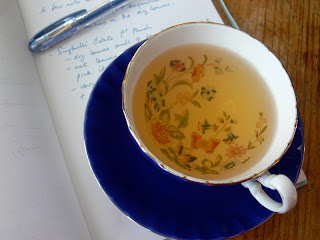
It is fruity, extremely puckery if oversteeped, malty and strong and sweet in the aftertaste, with a powerful wake up kick. I love it. It does tend to need milk to smooth it out but hey - in this autumn weather that's just the kind of tea I like. I'm having trouble going for green tea at the moment; although I usually enjoy it once it's made, I can't enthuse myself about it quite as much as I can in the warmer weather.
A google search for 'jamira estate assam' does not bring up any particularly detailed or indeed cheerful information about the estate. Workers' deaths and a cholera outbreak (it's not clear how recent). A depressing reminder that the tea that I enjoy so much does come with a lot of hidden costs.
Showing posts with label black tea. Show all posts
Showing posts with label black tea. Show all posts
Tuesday, 12 April 2011


Tuesday, 22 February 2011
Tea tasting comparison FAIL
Well, of all the brain dead things to do... I set up a little taste comparison between two 2009 Autumn Flush Darjeeling teas which I picked up inexpensively late last year from Thunderbolt Tea - one from Sungma Estate and one from Giddapahar. I've been drinking quite a bit of the Sungma on a daily basis but I wanted to compare it with the other.
So I set it all up, two teapots, two mugs (colour coordinated with the teapots if you please, although that was more by happenstance than design), warmed them all up, weighed the leaf (2g of each), steeped, poured... And then I couldn't remember which leaves I put in which pot.
FAIL!
The green mug brew was spicier, lighter; the blue mug brew was a bit thicker, darker tasting and slightly sweeter & more musky - so I think that one may have been the Giddapahar and the green mug the Sungma. I'm not sure though. at least they were both delicious.
I guess if at first you don't succeed...
So I set it all up, two teapots, two mugs (colour coordinated with the teapots if you please, although that was more by happenstance than design), warmed them all up, weighed the leaf (2g of each), steeped, poured... And then I couldn't remember which leaves I put in which pot.
FAIL!
The green mug brew was spicier, lighter; the blue mug brew was a bit thicker, darker tasting and slightly sweeter & more musky - so I think that one may have been the Giddapahar and the green mug the Sungma. I'm not sure though. at least they were both delicious.
I guess if at first you don't succeed...
Sunday, 13 February 2011
Sustainable, organic, fair trade tea
I am quite the groupie of Nigel Melican of Teacraft Ltd - his knowledge and experience in the industry is vast and I am always interested in what he has to say. So, you can imagine how rapt I was to discover that Cinnabar of Gongfu Girl had interviewed Nigel at last year's World Tea Expo and shared the interview on Cha Dao.
If you care about issues of sustainability, organic farming and fair trade - in relation to tea in particular of course, but I think there is much in this interview that applies to agriculture and trade in general - then you should read this. The following excerpt is one I found particularly thought provoking:
The interview is relatively lengthy, so it's been divided into three parts. Definitely worth every minute of your reading time and worth coming back to. Check it out here!
Part One
Part Two
Part Three
If you care about issues of sustainability, organic farming and fair trade - in relation to tea in particular of course, but I think there is much in this interview that applies to agriculture and trade in general - then you should read this. The following excerpt is one I found particularly thought provoking:
NM: I'll give you an example of the dilemma that you might get into. I was working with a new tea grower in Hawaii -- not one of the small guys that we've seen at the Expo, but someone who wanted to do it on a hundred-acre scale, 200-acre scale. He wanted to be organic, said the production must be organic. He was a berry farmer on the mainland, and he always had an organic farm, and he wanted to have an organic tea farm. So we started off and sourced his tea and his raw materials from Africa and got it planted, and his soil was not acid enough, which is unusual for Hawaii, but this was an old sugar-cane plantation and they'd put down a lot of chalk, to benefit the sugar cane. This was 20 years ago, but it was still there. The normal way that you'd acidify soil for tea is to put sulfur on it. Sulfur is recognized by the organic people; they're happy with it. So he goes off to his supplier and when he sees the sulfur that he's offered, he says, "where does it come from?" and they say it's a by-product of the petrochemical industry, and he throws his hands up in horror! So we look and see what else we can get. It's possible to get sulfur which is rock sulfur, mined sulfur. The dilemma is, would you rape the countryside with big holes, ripping out rock sulfur, or would you use a by-product of the petrochemical industry that has to go somewhere, and is at least greening the petrochemical industry at least a little bit?
C: Why would the organic regulations say that you couldn't use petro-chemical by-products?
NM: the regulations don't say that you shouldn't, but they would prefer that you use the natural sulfur.
C: "Organic" meaning that you take it from the earth regardless of consequences? That makes no sense.
NM: No it doesn't make a lot of sense. That's why I say that sustainability and organic should be done with some degree of realism.
The interview is relatively lengthy, so it's been divided into three parts. Definitely worth every minute of your reading time and worth coming back to. Check it out here!
Part One
Part Two
Part Three
Monday, 31 January 2011
What's a letter worth?

You know those letters that you see after the name of a tea - GFBOP, TGFOP, SFTGFOP1 etc etc - it's funny the effect they can have on my purchasing habits.
These letters are, for those of you who don't know, part of a grading system for orthodox-style black teas, primarily those from India and Sri Lanka (Ceylon as it used to be known). The basic is the OP - 'orange pekoe'. Many people will be surprised to learn that this has nothing to do with orange flavour in any way; it is actually all to do with leaf size. If there's a B in front of the OP, that stands for 'broken' and means the leaf pieces are not as whole as they could be.
T, G, F all stand for 'tippy' 'golden' and 'flowery' respectively and relate to the number of tips (leaf buds, which tend to turn golden rather than brown during the production process) in the tea. The more buds, the younger the leaves were at harvest, the finer the pluck, the more expensive the tea. Stick an S for 'special' and an F for 'finest' on the front of all that and you have a very fine tea indeed...
Or that's the theory anyway. In reality, the processing of the leaf probably has at least as much impact on the quality of the final product as the initial pluck. However, many people wandering into your average tea shop would not necessarily know this; and there is a bit of a 'wow factor' involved in purchasing something that has lots of letters after its name (just like looking at the business card of someone with a lot of university degrees I suppose). After all, wouldn't you like to have a bit of the most special (indeed the most finest??) tea in the shop?
But what are these letters worth really?
From a price perspective: The Assam that I wrote about the other day (see here) retails from Tea Leaves for the very reasonable price (as Alex pointed out in the comments) of A$5.50 for 100g (about 3oz). This tea is a TGFOP. In comparison, a STGFOP1 Assam retails from the same vendor for $10.45, nearly double the cost for the same quantity. These two teas may not be exactly comparable of course; for one thing, the more expensive tea is identified as a single estate tea whereas the one I bought is unidentified, presumably blended from a mixture of estates.
I almost came away with the more letter-heavy Assam; the main reason I didn't was because I happened to recall that this is a grading system based on size, not taste quality. So I reckoned I would save my pennies (well, only to spend them on some Dragonwell, ahem) and went with the cheaper version. Very happy I am with it too.
But even so - I wonder if the STGFOP1 would taste twice as nice? Or would I only think it did because it was more expensive? And anyway, doesn't it all come down to personal taste in the end? Perhaps when I run out of my current stock (which I am going through at quite a pace, I must say) I will get some of both to compare.
Thursday, 27 January 2011
Hello... yes, it's been a while.
Quite a while, just over three months in fact, since my last post. Blogging got a bit on top of me I'm afraid, when added to all the other things that I both need and want to get done on a daily basis; but I do miss it, and I would like to continue this tea blog. Although, given the number of in depth, well-researched, beautifully written tea blogs out there, i have had quite the crisis of confidence regarding this one and am not really sure of what of value I have to offer in the tea blogging world. But let's just give it another go, eh?
I have, of course, been drinking loads of tea - much more hot tea than is usual for me over the summer period because it has been most unseasonably chilly and wet... The wettest it has been in Melbourne for a LONG time... I can't remember the last time I saw things looking this green.
My current favourite tea, for its undemanding yet enjoyable nature, is a tippy Assam from Tea Leaves in Sassafras, where my sister and I ventured the other week. The dry leaves smell like a brandy-rich fruit cake; brewed the taste is not super-exciting, but pleasant and robust - amazingly, you can overbrew this tea (as I did one morning when I forgot about it for about ten minutes) yet it is still delightful and does not become bitter or astringent. I even drank it black after its ten-minute steep, that's how ok it was. Also nice with a spot of milk, but really, you don't need it. I like it a lot, at any time of day.
I hope you'll stick around to read on; I'm not going to commit to any kind of posting schedule because I'm really not certain what I can manage at the moment, so I'm just going to play it by ear. But please, do comment - I read each and every one even if I don't always manage to respond in any sort of timely fashion. And don't forget to have a cuppa while you're reading...
I have, of course, been drinking loads of tea - much more hot tea than is usual for me over the summer period because it has been most unseasonably chilly and wet... The wettest it has been in Melbourne for a LONG time... I can't remember the last time I saw things looking this green.
My current favourite tea, for its undemanding yet enjoyable nature, is a tippy Assam from Tea Leaves in Sassafras, where my sister and I ventured the other week. The dry leaves smell like a brandy-rich fruit cake; brewed the taste is not super-exciting, but pleasant and robust - amazingly, you can overbrew this tea (as I did one morning when I forgot about it for about ten minutes) yet it is still delightful and does not become bitter or astringent. I even drank it black after its ten-minute steep, that's how ok it was. Also nice with a spot of milk, but really, you don't need it. I like it a lot, at any time of day.
I hope you'll stick around to read on; I'm not going to commit to any kind of posting schedule because I'm really not certain what I can manage at the moment, so I'm just going to play it by ear. But please, do comment - I read each and every one even if I don't always manage to respond in any sort of timely fashion. And don't forget to have a cuppa while you're reading...
Tuesday, 5 October 2010
Risheehat Clonal Flowery Second Flush 2010
This second flush Risheehat is another lovely tea I purchased from Thunderbolt Tea (can't wait for my next order to arrive in a couple of weeks...) - I have been drinking lots of it over the last little while and enjoying it greatly!
When I first opened the packet there was a lovely burst of flowery aroma - roses? maybe gardenias? - sadly since it has been in its new tin the flowery scent has faded (it seems quite common for the taste and aroma of tea to change once it has been opened, no matter how well I try to store it) but there remains a very pleasant, rich warm smell in the dry leaves - it kind of reminds me of a dark spicy gingerbread, or almost chocolatey? It is not as 'muscatel'-smelling as some other Darjeeling teas that I've tried. This is not a complaint.
My nose is a bit blocked so I can't detect much in the wet leaves today, but previously I have noted some tropical fruit notes - pineapple definitely and a bit of passionfruit as well perhaps?
The brewed tea (3 minutes seems about right, as recommended on the website - scroll down to get to the Risheehat) is moderately brisk and makes my mouth tingle a bit. The further you get into the cup the cleaner and sweeter the lingering aftertaste. When my taste buds are functioning properly I can definitely detect those tropical fruit notes. 'Lush' is a word that comes to mind to describe this tea. The first infusion is the best; a second is possible but the flavour is fairly muted - although that said it is also forgiving, because half the time I pour in a second lot of water into the teapot and then can't get around to drinking it for quite a while!
When I first opened the packet there was a lovely burst of flowery aroma - roses? maybe gardenias? - sadly since it has been in its new tin the flowery scent has faded (it seems quite common for the taste and aroma of tea to change once it has been opened, no matter how well I try to store it) but there remains a very pleasant, rich warm smell in the dry leaves - it kind of reminds me of a dark spicy gingerbread, or almost chocolatey? It is not as 'muscatel'-smelling as some other Darjeeling teas that I've tried. This is not a complaint.
My nose is a bit blocked so I can't detect much in the wet leaves today, but previously I have noted some tropical fruit notes - pineapple definitely and a bit of passionfruit as well perhaps?
The brewed tea (3 minutes seems about right, as recommended on the website - scroll down to get to the Risheehat) is moderately brisk and makes my mouth tingle a bit. The further you get into the cup the cleaner and sweeter the lingering aftertaste. When my taste buds are functioning properly I can definitely detect those tropical fruit notes. 'Lush' is a word that comes to mind to describe this tea. The first infusion is the best; a second is possible but the flavour is fairly muted - although that said it is also forgiving, because half the time I pour in a second lot of water into the teapot and then can't get around to drinking it for quite a while!
Friday, 17 September 2010
Tea and Food: What to drink with breakfast
I don't really have a single tea that I could say is my 'breakfast' tea. I tend to drink something different each day depending on what I'm having for breakfast. The other morning my husband decided that we needed French toast with maple syrup and bacon - not perhaps the wisest decision on a weekday morning when (as it turned out) he had a relatively early meeting to get to work for, but that's as may be - which set me hunting through my pantry for an appropriate tea to go with such a hearty, savoury yet also sweet, breakfast.
It's common for Western-style breakfasts to be accompanied by powerful, wakey-uppy type teas, typically blends involving Assam and other brisk black teas that take milk and sugar well. See for example this brief Wikipedia article on English Breakfast tea, and for my thoughts on some common breakfast blends, have a peek here and here. If I'm going for one of these kinds of teas, Irish Breakfast would be my pick. However, I actually opted for some genmaicha to have alongside our impromptu fancy breakfast.
Genmaicha is a Japanese tea blend containing green tea and roasted rice kernels; perhaps a slightly perverse choice for morning drinking as the lower proportion of tea leaves means that it is significantly lower in caffeine content. It's not something that I drink on a very regular basis; it's an intensely savoury tea that tastes predominantly of the roasted rice with little green tea flavour (at least this is the case with the brand that I have, which is made by Ujinotsuyu). It is an excellent partner with many kinds of savoury food though, and went quite well with the smoky, sweet flavours of the maple syrup and bacon.
Other teas that you might like to consider with a substantial savoury breakfast include Lapsang Souchong (or add a little pinch to your regular plain black tea) or a darker-roasted wulong (oolong) like Da Hong Pao. Chinese gunpowder green could be good too, and plain or vanilla-flavoured rooibos would also be a great herbal option. I'd definitely steer clear of anything very flowery or too light.
It's common for Western-style breakfasts to be accompanied by powerful, wakey-uppy type teas, typically blends involving Assam and other brisk black teas that take milk and sugar well. See for example this brief Wikipedia article on English Breakfast tea, and for my thoughts on some common breakfast blends, have a peek here and here. If I'm going for one of these kinds of teas, Irish Breakfast would be my pick. However, I actually opted for some genmaicha to have alongside our impromptu fancy breakfast.
Genmaicha is a Japanese tea blend containing green tea and roasted rice kernels; perhaps a slightly perverse choice for morning drinking as the lower proportion of tea leaves means that it is significantly lower in caffeine content. It's not something that I drink on a very regular basis; it's an intensely savoury tea that tastes predominantly of the roasted rice with little green tea flavour (at least this is the case with the brand that I have, which is made by Ujinotsuyu). It is an excellent partner with many kinds of savoury food though, and went quite well with the smoky, sweet flavours of the maple syrup and bacon.
Other teas that you might like to consider with a substantial savoury breakfast include Lapsang Souchong (or add a little pinch to your regular plain black tea) or a darker-roasted wulong (oolong) like Da Hong Pao. Chinese gunpowder green could be good too, and plain or vanilla-flavoured rooibos would also be a great herbal option. I'd definitely steer clear of anything very flowery or too light.
Monday, 13 September 2010
Cooking With Tea - Barm Brack
I didn't think I would ever find a tea-soaked fruit cake that I would like better than my beloved Marmalade Tea Loaf, but I have. It's the Barm Brack recipe from (appropriately enough) the Nursing Mothers' Association of Australia cookbook.*

Barm Brack is an Irish fruit loaf, often served with a cup of tea in the afternoon; it may be yeasted, or not.

The version I made is unyeasted, and could not be simpler. You are meant to soak the fruit in the tea overnight; I wasn't that organised but it didn't seem to matter (thought I should probably do it properly next time). The recipe in the NMAA book says you can use mixed dried fruit or a single one; I opted for currants and soaked them in a strong cup's worth of Ceylon tea - although I suppose Irish Breakfast would be most appropriate!
Here's the recipe as I made it:

I can't tell you how well this went with a pot of Margaret's Hope 'Silver Moon' second flush Darjeeling (from Thunderbolt Tea) - the currants and the muscatel flavour of the Darjeeling were perfect together.
*My mum cooked lots of stuff from this when I was little, and still goes to it for many cakes, which are all delicious. She bought me a new copy just before I had Pippin; it is unchanged - and I mean unchanged, curried sausages with sultanas and all - from the original 1975 version. I'm not game to make the curried sausages as I have less-than-fond memories of them from my childhood, but the cakes and slices really are excellent.

Barm Brack is an Irish fruit loaf, often served with a cup of tea in the afternoon; it may be yeasted, or not.

The version I made is unyeasted, and could not be simpler. You are meant to soak the fruit in the tea overnight; I wasn't that organised but it didn't seem to matter (thought I should probably do it properly next time). The recipe in the NMAA book says you can use mixed dried fruit or a single one; I opted for currants and soaked them in a strong cup's worth of Ceylon tea - although I suppose Irish Breakfast would be most appropriate!
Here's the recipe as I made it:
500g currants250ml strong black tea, hot1 cup brown sugar2 cups self-raising flour1 egg
Mix the currants and sugar together and soak in the strained hot tea for an hour or so (or ues cold tea and soak overnight).Preheat oven to 150C and thoroughly grease a large (9in by 5in) loaf pan (if it's not non-stick you may want to line it as well just to be sure)Stir the flour and the beaten eggs thoroughly into the fruit mixture. Pour into the prepared tin and bake at 150C for about 2 hours (mine took about 1 hour 50 minutes).Allow to cool for 15 minutes in the tin, then turn out and cool completely.Serve sliced with butter and a cup of your best black tea.

I can't tell you how well this went with a pot of Margaret's Hope 'Silver Moon' second flush Darjeeling (from Thunderbolt Tea) - the currants and the muscatel flavour of the Darjeeling were perfect together.
*My mum cooked lots of stuff from this when I was little, and still goes to it for many cakes, which are all delicious. She bought me a new copy just before I had Pippin; it is unchanged - and I mean unchanged, curried sausages with sultanas and all - from the original 1975 version. I'm not game to make the curried sausages as I have less-than-fond memories of them from my childhood, but the cakes and slices really are excellent.
Thursday, 9 September 2010
Tea Stuff Roundup - Assam, & Mind Your Health Claims
I came across a link to this interesting article about the increase in the number of small farmers producing tea in Assam, India. The farmers grow the leaves and then sell them to larger companies to be turned into made tea. This can provide a significant and steady source of income for the farmers, which is great, although there may be some concerns about quality. However, since better leaf fetches higher prices at auction, i presume there's a strong incentive for the farmers to improve where they can.
Also spotted via Twitter, my main (only?) connection to the external world since I never pay any attention to current affairs, this article about Lipton in the US getting warned off by the FDA for making tea-related health claims. It is simultaneously funny and depressing to see companies claiming that their highly processed, sugar-filled, RTD teas are 'good for you' - come on, it's non-fizzy soft drink, people!
Plus it appears that the antioxidants in tea degrade over time, so fresh is going to be better than bottled - but we knew that anyway!
Finally, I boggled when I read this here:
To be honest, I think that anyone who was drinking that much (14 LITRES? How could you manage it?) of anything might end up just a little bit potassium deficient...
Also spotted via Twitter, my main (only?) connection to the external world since I never pay any attention to current affairs, this article about Lipton in the US getting warned off by the FDA for making tea-related health claims. It is simultaneously funny and depressing to see companies claiming that their highly processed, sugar-filled, RTD teas are 'good for you' - come on, it's non-fizzy soft drink, people!
Plus it appears that the antioxidants in tea degrade over time, so fresh is going to be better than bottled - but we knew that anyway!
Finally, I boggled when I read this here:
Tea is generally considered to be safe, even in large amounts. However, two cases of hypokalemia (abnormally low serum potassium levels) in the elderly have been attributed to excessive consumption of black and oolong tea (3-14 liters/day).
To be honest, I think that anyone who was drinking that much (14 LITRES? How could you manage it?) of anything might end up just a little bit potassium deficient...
Tuesday, 17 August 2010
Tuesday's Tea of the Week - Chai Masala
I LOVE chai masala. There is something so comforting about a good cup of milky sweet spicy tea... A really special treat. There are obviously dozens of ways of making such a blend, and this is the one I've come up with for the shop. I think it's well balanced... No single spice predominating, just all round yumminess.

Along with the organic black tea, in this blend there you will find cinnamon, ginger, allspice, cardamom, fennel and black pepper - so many of my favourite things!
The good thing about this tea is that while it's delicious prepared the traditional way, by gradually bringing milk to boil on the stove top etc, it actually also works really well made a bit more quickly, just infused in boiling water in a teapot and with the milk added after, to taste.

I find that the cinnamon makes it sweet enough for my taste without anything added, but of course you can add some honey or sugar if you like! Perfect for curling up with on a cold winter evening - or for serving alongside your Indian dinner! If you have a milk frother, you can also make your own genuine chai latte, too easy (and 100 times better than anything made from chai 'powder' or 'syrup').
Next week: Outback Sunset

Along with the organic black tea, in this blend there you will find cinnamon, ginger, allspice, cardamom, fennel and black pepper - so many of my favourite things!
The good thing about this tea is that while it's delicious prepared the traditional way, by gradually bringing milk to boil on the stove top etc, it actually also works really well made a bit more quickly, just infused in boiling water in a teapot and with the milk added after, to taste.

I find that the cinnamon makes it sweet enough for my taste without anything added, but of course you can add some honey or sugar if you like! Perfect for curling up with on a cold winter evening - or for serving alongside your Indian dinner! If you have a milk frother, you can also make your own genuine chai latte, too easy (and 100 times better than anything made from chai 'powder' or 'syrup').
Next week: Outback Sunset
Tuesday, 3 August 2010
Tuesday's Tea of the Week: Lemon Myrtle Basic Black
I am slightly in love with lemon myrtle, I think. I like it better than lemongrass (although that is also good stuff). I can't tell you how much I love opening up my bulk bags of lemon myrtle tea; the aroma is sensational. If I could bottle it I would. Also using lemon myrtle makes me feel wonderfully Australian in a refined rather than bogan manner.
Lemon myrtle is a little bitter and overpowering on its own though, which is why I include it in quite a few blends (Rainforest, Outback Sunset, Lemon Breeze) but rarely drink it on its own.

Lemon Myrtle Basic Black is a fantastically complementary combination. The zestiness of the lemon myrtle is offset by the very slight astringency of the black tea base; it's fragrant and delicate enough for an afternoon tea party but also refreshing and energising.

The black tea does contain caffeine but because at least half the bulk of the dry leaf is herbal, it's not that strong so should be less of a concern for those of you who are cautious about caffeine intake. Both the lemon myrtle and the black tea are organic as well.
Next week: Relax
Lemon myrtle is a little bitter and overpowering on its own though, which is why I include it in quite a few blends (Rainforest, Outback Sunset, Lemon Breeze) but rarely drink it on its own.

Lemon Myrtle Basic Black is a fantastically complementary combination. The zestiness of the lemon myrtle is offset by the very slight astringency of the black tea base; it's fragrant and delicate enough for an afternoon tea party but also refreshing and energising.

The black tea does contain caffeine but because at least half the bulk of the dry leaf is herbal, it's not that strong so should be less of a concern for those of you who are cautious about caffeine intake. Both the lemon myrtle and the black tea are organic as well.
Next week: Relax
Sunday, 1 August 2010
Daintree Tea
Yes folks, tea grows in Australia too, up the top in sunny Queensland!
The other week a friend of mine was making a trip to Sassafras and offered to get me some tea from Tea Leaves... I was going to be good and say 'No' but then I didn't, because I am a naughty, naughty tea fiend at heart, and asked her to get me some Daintree tea and some Nilgiri, neither of which I have tried before. Actually, that's not quite true - I have had Daintree tea before, in a blend - Hari Har Chai - but not on its own.

I've been drinking quite a lot of the Daintree over the last week and getting to know it a bit better. According to the Tea Leaves site, this is:
I've brewed the tea at three minutes (two infusions), four minutes and five minutes (single infusion). The first three-minute infusion was my favourite (the second was a bit of a waste of time). The wet leaves had an aroma of raspberries and possibly gingerbread, and a faint yet distinct smell of star anise or maybe liquorice (the confectionery not the herb). This aniseedy flavour carries over, still faintly, into the brewed tea which is a beautiful clear copper colour.
I was actually expecting this to be quite astringent and need milk once I got past the four-minute infusion mark, but even at five minutes it's quite ok black. It does leave my tongue feeling dry though; not as thirst-quenching as some teas can be. The flavours I mentioned just before kind of disappear though and it just tastes... boring, I think is the only word to describe it. Bit of milk and sugar though and it would be quite an acceptable and comforting cuppa for those days when what you want is a cup of tea just like your mum or dad used to make when you were little.
(Side note: dubiously, the Daintree tea website claims that their tea contains 'no tannic acid'. This is both true and slightly misleading, because as I understand it, NO tea contains tannic acid... just polyphenols [a type of tannin, which is different from tannic acid]. I'm doing a little more research into this, although I'm no chemist, and hope to post about it in the near future)
The other week a friend of mine was making a trip to Sassafras and offered to get me some tea from Tea Leaves... I was going to be good and say 'No' but then I didn't, because I am a naughty, naughty tea fiend at heart, and asked her to get me some Daintree tea and some Nilgiri, neither of which I have tried before. Actually, that's not quite true - I have had Daintree tea before, in a blend - Hari Har Chai - but not on its own.
Image from Tea Leaves site.
I've been drinking quite a lot of the Daintree over the last week and getting to know it a bit better. According to the Tea Leaves site, this is:
A superb black tea, grown near the Daintree rainforest of northern Queensland. The rich, fertile, lowland soil produces a well-rounded, medium strength tea.I don't know if I would describe this as superb,; it's not ever going to make my list of top teas, but it's enjoyable enough. The dry leaves (as you can see in the photo above) are very small CTC with quite a bit of (what I think are) thin pieces of stem. They have a faint smell of strawberries.
I've brewed the tea at three minutes (two infusions), four minutes and five minutes (single infusion). The first three-minute infusion was my favourite (the second was a bit of a waste of time). The wet leaves had an aroma of raspberries and possibly gingerbread, and a faint yet distinct smell of star anise or maybe liquorice (the confectionery not the herb). This aniseedy flavour carries over, still faintly, into the brewed tea which is a beautiful clear copper colour.
I was actually expecting this to be quite astringent and need milk once I got past the four-minute infusion mark, but even at five minutes it's quite ok black. It does leave my tongue feeling dry though; not as thirst-quenching as some teas can be. The flavours I mentioned just before kind of disappear though and it just tastes... boring, I think is the only word to describe it. Bit of milk and sugar though and it would be quite an acceptable and comforting cuppa for those days when what you want is a cup of tea just like your mum or dad used to make when you were little.
(Side note: dubiously, the Daintree tea website claims that their tea contains 'no tannic acid'. This is both true and slightly misleading, because as I understand it, NO tea contains tannic acid... just polyphenols [a type of tannin, which is different from tannic acid]. I'm doing a little more research into this, although I'm no chemist, and hope to post about it in the near future)
Thursday, 22 July 2010
Tea and Food: what to drink with chocolate
Last week I made some rather fabulous dark chocolate brownies, which I ended up eating accompanied by several different kinds of tea over the course of the week. Some pairings were more successful than others, and this set me to thinking that a series of posts about tea and food might not be a bad idea. If you have a particular kind of food you'd like me to focus on, just place a request in the comments and I'll do my best to accommodate it (barring seafood, of which I am not a fan).
So here's this week's instalment: teas to pair with CHOCOLATE - cake, brownies, or just all on it's lonesome own. Aw.

My first recommendation: jasmine tea. I find that jasmine goes beautifully with moderately dark chocolatey things; the sweet floral taste offsets the slightly bitter chocolate very well. Even though I often prefer to drink my really good teas on their own, without any disruption to their flavour caused by combining them with food, I think it is actually worthwhile cracking out the good jasmine tea to have with your chocolate, simply because the jasmine flavour will be stronger. Keep the lower-rent jasmine for having with your Chinese takeaway and have a really top-notch one (I have still got some of the 2009 Moli Jin Zhen Wang from Amazing Green Tea which is just divine).
Second recommendation: a strong Japanese green - sencha or matcha, or why not both (like the Macchairi Kabuse Ryokucha I blogged about here). The bitter-sweetness of the tea and chocolate play off each other and the greenness of the tea cuts through the richness of the chocolate as well. I thought jasmine and chocolate was my favourite until I tried this. It's really an incredible combination.
If you are looking for a black tea I would go for something robust and a bit astringent like an Assam, or fruity like a second or Autumn flush Darjeeling; the taste of a first flush Darjeeling gets overwhelmed by the chocolate. I also felt that my beloved Yunnan Golden Tips didn't shine as I would have liked when I drank it alongside the brownie (which you can see in the corner of the picture in that post!). Earl Grey is a good option though and one I often choose when I am out somewhere like Koko Black; the floral/citrus taste of the bergamot is refreshing and also cuts through the richness.
So here's this week's instalment: teas to pair with CHOCOLATE - cake, brownies, or just all on it's lonesome own. Aw.

Just crying out for some tea to keep it company!
My first recommendation: jasmine tea. I find that jasmine goes beautifully with moderately dark chocolatey things; the sweet floral taste offsets the slightly bitter chocolate very well. Even though I often prefer to drink my really good teas on their own, without any disruption to their flavour caused by combining them with food, I think it is actually worthwhile cracking out the good jasmine tea to have with your chocolate, simply because the jasmine flavour will be stronger. Keep the lower-rent jasmine for having with your Chinese takeaway and have a really top-notch one (I have still got some of the 2009 Moli Jin Zhen Wang from Amazing Green Tea which is just divine).
Second recommendation: a strong Japanese green - sencha or matcha, or why not both (like the Macchairi Kabuse Ryokucha I blogged about here). The bitter-sweetness of the tea and chocolate play off each other and the greenness of the tea cuts through the richness of the chocolate as well. I thought jasmine and chocolate was my favourite until I tried this. It's really an incredible combination.
If you are looking for a black tea I would go for something robust and a bit astringent like an Assam, or fruity like a second or Autumn flush Darjeeling; the taste of a first flush Darjeeling gets overwhelmed by the chocolate. I also felt that my beloved Yunnan Golden Tips didn't shine as I would have liked when I drank it alongside the brownie (which you can see in the corner of the picture in that post!). Earl Grey is a good option though and one I often choose when I am out somewhere like Koko Black; the floral/citrus taste of the bergamot is refreshing and also cuts through the richness.
Wednesday, 14 July 2010
Yunnan Golden Tips
I have been reading over at Jenny's Blog about her quest for the perfect selection of teas for her cabinet... ten teas that she loves enough to always have on hand. It's an ongoing search (but what a fun one, huh?). I hadn't ever thought about selecting teas in this way; but if I were going to start a Top-10 teas to always have in my cupboard, Yunnan Golden Tips from SanTion would definitely be on my list.

The leaves are incredible, so long and tippy, it is absolutely full of golden buds (as the name would suggest). My favourite part is actually opening the canister - there is such a rich smell of sweet raisins that greets me. Immensely cheering on a cold grey day. The wet leaves have a creamy, slightly spicy smell. The liquor is very smooth, no bitterness or astringency - just a rich round flavour with a touch of spice and also flowers, I think. A little malty as well.
I am going through this tea at a rapid rate and will shortly have to order more. It is just such easy drinking.

Apologies for the blurriness of this photo; I took it without realising that the camera was on
manual focus not auto focus, and drank all the tea before I could take another. Whoops.
The leaves are incredible, so long and tippy, it is absolutely full of golden buds (as the name would suggest). My favourite part is actually opening the canister - there is such a rich smell of sweet raisins that greets me. Immensely cheering on a cold grey day. The wet leaves have a creamy, slightly spicy smell. The liquor is very smooth, no bitterness or astringency - just a rich round flavour with a touch of spice and also flowers, I think. A little malty as well.
I am going through this tea at a rapid rate and will shortly have to order more. It is just such easy drinking.
Wednesday, 7 July 2010
Singbulli First Flush 2010
My tastebuds are not fully operational after the rotten cold I have had (another one!) but here are a few little notes on the Singbulli First Flush tea (Clonal Classic Super Fine) that I received from Thunderbolt Tea a few weeks ago.
The dry leaves smell faintly of hay or sweet cut grass. They are lovely to look at (check them out in this post here). The wet leaves vary in colour between shades of copper and medium green:

They have a vegetal smell that I can't quite name... maybe nettles? Or asparagus?
The liquor is a very pale golden colour, honey-like in aroma. It has a light, bright flavour, not a lot of body; it is mainly vegetal in taste - but not brothy/seaweedy like a Japanese green - think more along the lines of silverbeet or chard rather than spinach. A faint hint of roses and possibly honey as well?
The dry leaves smell faintly of hay or sweet cut grass. They are lovely to look at (check them out in this post here). The wet leaves vary in colour between shades of copper and medium green:

They have a vegetal smell that I can't quite name... maybe nettles? Or asparagus?

The liquor is a very pale golden colour, honey-like in aroma. It has a light, bright flavour, not a lot of body; it is mainly vegetal in taste - but not brothy/seaweedy like a Japanese green - think more along the lines of silverbeet or chard rather than spinach. A faint hint of roses and possibly honey as well?
Tuesday, 6 July 2010
Tuesday's Tea of the Week: Vanilla Basic Black
Another member of my tea-plus-one-other-ingredient 'Basic Black' range, the Vanilla Basic Black is deservedly (if I do say so myself) one of my most popular teas. Black tea and finely chopped vanilla beans... that's it. This means that the fragrance and flavour is true vanilla... not some kind of artificial flavour that so often disappoints in vanilla teas.

The other great thing about this tea is its versatility. It's obviously delicious on its own, or you can add a splash of milk and even sugar and it still holds up extremely well. I love it alongside my breakfast - perfect for when I want something just a bit more special than regular plain black tea - but if you go the more decadent route of adding the aforesaid milk and sugar it makes a beautiful dessert all by itself.

Next week: Ruby-Red Mint
The other great thing about this tea is its versatility. It's obviously delicious on its own, or you can add a splash of milk and even sugar and it still holds up extremely well. I love it alongside my breakfast - perfect for when I want something just a bit more special than regular plain black tea - but if you go the more decadent route of adding the aforesaid milk and sugar it makes a beautiful dessert all by itself.
Next week: Ruby-Red Mint
Saturday, 19 June 2010
True Diversi-tea
Ok, I couldn't resist the pun, but take a look at this anyway... four different kinds of black tea, and how different they all are:


Arya Autumnal Darjeeling

Ceylon orange pekoe

Singbulli STFGOP First Flush Darjeeling

Yunnan Golden Tips
Tuesday, 4 May 2010
Tuesday's Tea of the Week: Star Anise Basic Black.
I thought I might spend a little time introducing you all a bit more to the blends that I make... so here is the first post in a new series: Star Anise Basic Black.
This blend is, as the name indicates, part of my 'Basic Black' tea range - organic black tea from Ceylon (Sri Lanka) mixed with a single other herb or spice, allowing the flavours of both ingredients to shine through with eloquent simplicity.

I was inspired to make this blend by a good friend of mine who has a tremendous love for star anise. The heady liquorice flavour of the spice goes beautifully with the smooth base of the black tea and is wonderfully invigorating yet also elegant.

It makes for an exquisite tea to serve after dinner with dessert... and a good digestif as well.
Next week: Lemon Breeze.
This blend is, as the name indicates, part of my 'Basic Black' tea range - organic black tea from Ceylon (Sri Lanka) mixed with a single other herb or spice, allowing the flavours of both ingredients to shine through with eloquent simplicity.

I was inspired to make this blend by a good friend of mine who has a tremendous love for star anise. The heady liquorice flavour of the spice goes beautifully with the smooth base of the black tea and is wonderfully invigorating yet also elegant.

It makes for an exquisite tea to serve after dinner with dessert... and a good digestif as well.
Next week: Lemon Breeze.
Tuesday, 30 March 2010
Battle of the Breakfast Blends - Part Two
So... have you all been dying of suspense?? Here they are at last... the tasting notes!
First off, I tried taking photos of each of the different cups of tea... and basically they all looked like this:

The Scottish Breakfast was a little lighter in colour, a little clearer; but they were all pretty similar. The taste though was quite distinct for each!
The basics: I brewed about 3g of leaf in about 200ml water for each tea, for 4 minutes (as recommended on The Tea Centre website). I tasted each black initially and then with the addition of milk, no sugar.
English Breakfast: this is described on The Tea Centre website as 'blend of leaves from India and Ceylon with a strong flavour'. Well, the first part may well be true, but the rest of it is not. English Breakfast tastes and smells like the most basic, traditional tea that you grew up with (if you come from a Western background). It has a good rich burnt umber colour but the flavour is just not that strong, or that interesting for that matter. A touch of astringency which is smoothed out by the milk, but not a great deal of character.
Irish Breakfast: Drinking this black first off, my tastebuds went 'WHOA' and then 'wheee!' and did a little dance. This. Is. Astringent. And strong and a bit bitter. And then, after a short while, nicely sweet and malty. I can't drink a whole cup of this without milk; maybe I could if I brewed it for only 2 minutes, but that's not really the point is it? This is definitely what I think of as a 'breakfast tea' - a really powerful wake-you-up kick... but a genuinely pleasant flavour as well.
Scottish Breakfast: This is possibly the most interesting and unusual of the three blends. I actually thought that it was a Yunnan blend but apparently it's Assam and Kenyan. It's got a deep musky-malty aroma and flavour. I actually prefer this one without milk, and based on my other experiments with it, brewed for a slightly shorter period of time (3 minutes) which lets the fruitier notes of the Kenyan tea through better I think.
To sum up:
English Breakfast - boring, I wouldn't bother.
Irish Breakfast - wham! wakes you up!
Scottish Breakfast - intriguing and enjoyable.
This was fun. I think I'm going to play more teas off against each other in the future.
First off, I tried taking photos of each of the different cups of tea... and basically they all looked like this:

The Scottish Breakfast was a little lighter in colour, a little clearer; but they were all pretty similar. The taste though was quite distinct for each!
The basics: I brewed about 3g of leaf in about 200ml water for each tea, for 4 minutes (as recommended on The Tea Centre website). I tasted each black initially and then with the addition of milk, no sugar.
English Breakfast: this is described on The Tea Centre website as 'blend of leaves from India and Ceylon with a strong flavour'. Well, the first part may well be true, but the rest of it is not. English Breakfast tastes and smells like the most basic, traditional tea that you grew up with (if you come from a Western background). It has a good rich burnt umber colour but the flavour is just not that strong, or that interesting for that matter. A touch of astringency which is smoothed out by the milk, but not a great deal of character.
Irish Breakfast: Drinking this black first off, my tastebuds went 'WHOA' and then 'wheee!' and did a little dance. This. Is. Astringent. And strong and a bit bitter. And then, after a short while, nicely sweet and malty. I can't drink a whole cup of this without milk; maybe I could if I brewed it for only 2 minutes, but that's not really the point is it? This is definitely what I think of as a 'breakfast tea' - a really powerful wake-you-up kick... but a genuinely pleasant flavour as well.
Scottish Breakfast: This is possibly the most interesting and unusual of the three blends. I actually thought that it was a Yunnan blend but apparently it's Assam and Kenyan. It's got a deep musky-malty aroma and flavour. I actually prefer this one without milk, and based on my other experiments with it, brewed for a slightly shorter period of time (3 minutes) which lets the fruitier notes of the Kenyan tea through better I think.
To sum up:
English Breakfast - boring, I wouldn't bother.
Irish Breakfast - wham! wakes you up!
Scottish Breakfast - intriguing and enjoyable.
This was fun. I think I'm going to play more teas off against each other in the future.
Saturday, 27 March 2010
Battle of the Breakfast Blends - Part One
I have recently become consumed with a desire to apprentice myself to a master tea blender and learn oodles of exciting tea-blending secrets... well, that's easier said than done (master tea blenders apparently being thin on the ground in Melbourne - but if you happen to be one, and are reading this, please get in touch), so in the meantime I have decided to do a bit of D.I.Y. blend-tasting and experimentation.
Blends seem to divide tea enthusiasts. By their very nature, branded/named blends are designed to be consistent in flavour across the years. This has advantages for consumers who like consistency in their cup; they can be pretty confident that they're getting what they like (or avoiding what they don't) and not have to worry about the potential variations in quality and flavour that can affect tea harvests.
To some, this consistency goes against the spirit of tea, denying the natural mutability of the tea experience. To others, however, the skill required to combine teas of different grade and origin in order to produce the required result is a cause for celebration. I think there's room for both these views (and, unsurprisingly, that the quality of the teas involved is of paramount importance).
Where to start?
English Breakfast and Irish Breakfast are two classic and popular blends that I have not given much thought to in the past - but I think they deserve a bit of closer attention. And who knew - there's a Scottish Breakfast blend as well. So in a bonanza of UK-tea-orientation I ordered up a small quantity of these three from The Tea Centre.
I've been drinking a bit of each over the last couple of weeks, but I'll save the tasting notes for another time. Today we'll start with a comparison of the dry leaf. [At the time of writing The Tea Centre's website is down... I will update hyperlinks to each of the blends when I can]
Close inspection reveals that each looks quite different...
English Breakfast: mainly very very fine brownish-red particles but with a good proportion of slightly longer, black, finely twisted leaf. The aroma of the dry leaves is light and a little lemony.

Irish Breakfast: mostly dark brown CTC leaf (see the tiny little clumpy balls - looks like the Assam Dimakusi BOP that I've had in the past) mixed with some longer twisty black leaf and a scattering of golden tips. The aroma is warm and slightly spicy.

Scottish Breakfast: full orthodox-style finely twisted leaf, dark browny-black in colour, no tips. The leaves smell fruity and rich.

Stay tuned for the tasting notes. I'll hopefully get a couple done today, before the cold I've been battling fully stuffs up my nose and I can't taste anything, let alone tea...
Blends seem to divide tea enthusiasts. By their very nature, branded/named blends are designed to be consistent in flavour across the years. This has advantages for consumers who like consistency in their cup; they can be pretty confident that they're getting what they like (or avoiding what they don't) and not have to worry about the potential variations in quality and flavour that can affect tea harvests.
To some, this consistency goes against the spirit of tea, denying the natural mutability of the tea experience. To others, however, the skill required to combine teas of different grade and origin in order to produce the required result is a cause for celebration. I think there's room for both these views (and, unsurprisingly, that the quality of the teas involved is of paramount importance).
Where to start?
English Breakfast and Irish Breakfast are two classic and popular blends that I have not given much thought to in the past - but I think they deserve a bit of closer attention. And who knew - there's a Scottish Breakfast blend as well. So in a bonanza of UK-tea-orientation I ordered up a small quantity of these three from The Tea Centre.
I've been drinking a bit of each over the last couple of weeks, but I'll save the tasting notes for another time. Today we'll start with a comparison of the dry leaf. [At the time of writing The Tea Centre's website is down... I will update hyperlinks to each of the blends when I can]
Close inspection reveals that each looks quite different...
English Breakfast: mainly very very fine brownish-red particles but with a good proportion of slightly longer, black, finely twisted leaf. The aroma of the dry leaves is light and a little lemony.

Irish Breakfast: mostly dark brown CTC leaf (see the tiny little clumpy balls - looks like the Assam Dimakusi BOP that I've had in the past) mixed with some longer twisty black leaf and a scattering of golden tips. The aroma is warm and slightly spicy.

Scottish Breakfast: full orthodox-style finely twisted leaf, dark browny-black in colour, no tips. The leaves smell fruity and rich.

Stay tuned for the tasting notes. I'll hopefully get a couple done today, before the cold I've been battling fully stuffs up my nose and I can't taste anything, let alone tea...
Subscribe to:
Posts (Atom)
LinkWithin
